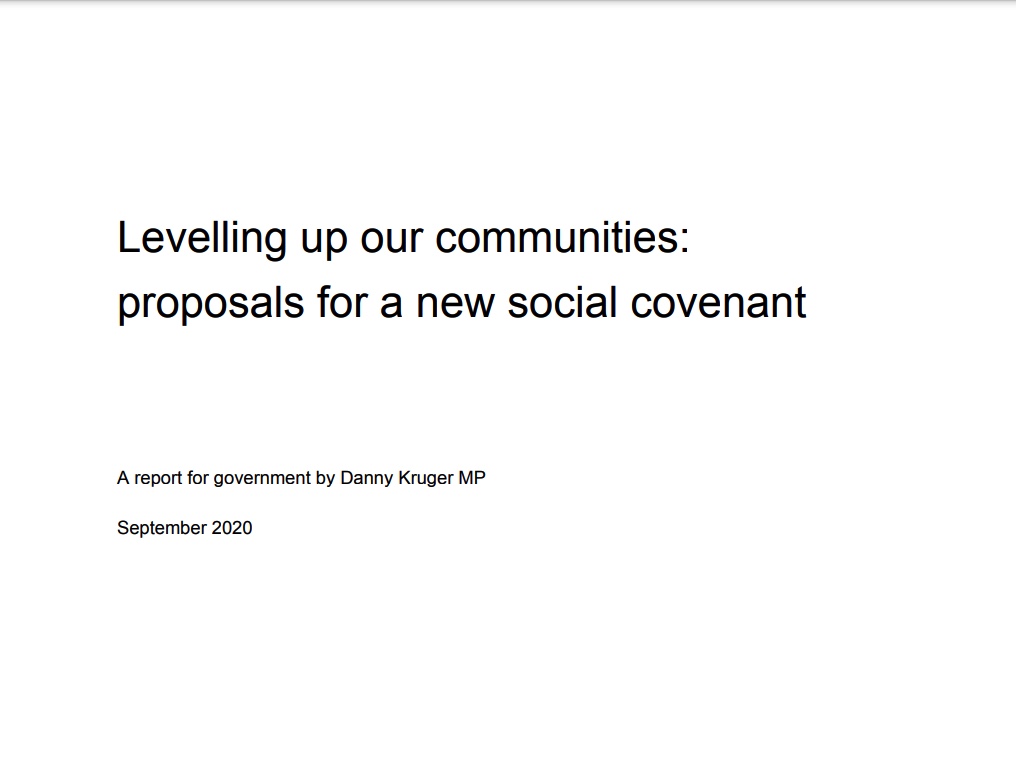
Last week the government published the ‘Levelling up our communities: proposals for a new social covenant’, report by Danny Kruger MP which has recommendations and suggestions for developing civil society based on the amazing response by the voluntary and community sector to the Covid-19 pandemic. In late June Danny was asked [note: I am not actually on first named terms with him, but for the purpose of this article I shall be. Just go with it] by our Prime Minister, who I am not on first name terms with, to look into the sector’s response and a month later he submitted his report.
There is a lot covered and suggested in the 52 page report and some of what Danny writes and concludes are firm recommendations to implement and others are more ‘why don’t we try this?’ suggestions. I am not going to forensically analyse all of the report but here are my thoughts and responses to what I see as the highlights regarding the charity sector and volunteering as this is my professional area of expertise. [For those who don’t know me, I run 2 independent volunteering charities and a social enterprise]
There is a lot in the report that our sector should take forward but there are also some recommendations and suggestions that are either incorrect or I personally do not agree with. However, I must say I agree with the spirit and intention of most of the report and feel this a great marker in the ground and an opportunity the sector should seize and take forward. We should perhaps not focus on the precise detail and mechanics of the recommendations, but the spirit and high-level intentions and work with Danny and the government to find the best way to achieve them.
“The big message I take away is that Kruger thinks the work of charities should be valued higher, the sector should have more money, there should be more and easier ways to volunteer, businesses are and should be increasingly part of civil society, social value procurement should be far more effective and we should value and put more importance on local power and spaces. That is great! Let’s run with this, work together and make this happen.“
Dominic Pinkney
Of the 20 specific recommendations of the report, the key ones I believe we should seize upon are:
Kruger Recommendation #1. New official measures to understand and track the economic and social contribution of civil society
Kruger Recommendation #3. Negotiation with Big Tech firms to finance and co-design new, non-proprietary digital infrastructure for communities
Kruger Recommendation #4. A new commitment to ‘social value’ commissioning, considering the whole of government accounts rather than a single budget
Kruger Recommendation #17 Options to boost philanthropy, including civic crowdfunding, and social investment
Kruger Recommendation #18 A new £500m Community Recovery Fund, financed by the allocation of the dormant National Fund, for charities and community groups supporting the transition from the ‘response’ to the ‘recovery’ phase
Kruger Recommendation #19 Consult on the use of the £2bn+ which will shortly be available from new dormant assets: options include a new endowment, the Levelling Up Communities (LUC) Fund, for perpetual investment in long-term, transformational, community-led local projects in left-behind areas
Building on what Danny has said I have also added my recommendations:
Dominic’s Recommendation #1
(a) Government commits to helping to get all of the £750million already awarded out to charities and community organisations who need it as soon as possible.
(b) A commitment of more financial support to the sector.
Dominic’s recommendation #2 – To evidence how businesses will deliver social value priorities they will need to demonstrate written support from the voluntary and community sector.
Dominic’s Recommendation #3 – Agreement of Government and the voluntary and community sector to work together to look at mechanisms such as volunteer passports that make it easier for a volunteer to start volunteering and recognise other volunteering they have carried out.
Dominic’s Recommendation #4 – Empower and enhance local volunteering infrastructure to better able to mobilise, broker and support volunteering in all of its forms, both informal and formal in both crisis and non-crisis times.
Dominic’s Recommendation #5 – Develop nationally agreed guidelines for how volunteers can support emergencies
Dominic’s recommendation #6 – Produce a plan, led by the voluntary and community sector, with detailed recommendations to develop a coordinated business volunteering support
Dominic’s recommendation #7 – Support local volunteering infrastructure to pro-actively help VIOs to adapt to offer more informal volunteer roles
Dominic’s Recommendation #8 – National campaign to promote the role of Trustee along with a review and discussion of mechanisms to improve diversity of boards.
Dominic’s Recommendation #9 – Commitment by the government to collaborate and work with the voluntary and community sector to develop this
Constructive Criticism and Volunteering Context
Where I am critical of the report, in a constructive let’s-still-take-this-forward-but-in-a-different-way, is regarding the recommendations and suggestions for volunteering. Danny spends the first half of the report advocating strongly and convincingly for more local control and power but then when it comes to volunteering seems to be arguing for a government centralised database. I feel strongly that his arguments for local control should also apply to volunteering and that approach will reap greater benefits and impact.
Danny also discusses, in a high-level way, that the Big Society initiative was partly unsuccessful as it seemed that the government was asking the public to give up their time to replace the reduction in services resulting from austerity measures. I agree with this analysis, but he misses one of the main reasons why Big Society failed, and it had nothing to do with austerity. It was because Big Society was a government-led scheme.
Rightly or wrongly, if the government asks people to volunteer in non-crisis conditions, the public does not respond well to this request. Volunteering is and always should be free choice and when the government asks for people to volunteer the ask is, unfortunately, tainted and there is scepticism and mistrust. It does not matter which party is in power, if central or even local government tries to run and promote a volunteer scheme it is never does as well as when it is led by the voluntary and community sector.
My strong recommendation would be for the government to take the first part of Danny’s report and apply it to volunteering and for the government to support and invest in local areas to have more control and resources to develop volunteering.
Danny has a strong charity background and a good understanding of the sector, which is really helpful to this report, but he does not have expertise in volunteering. He was only given a month to put together this report and so it is understandable that he was not able to obtain all the necessary input to recommend a strategy to develop volunteering that will deliver the results he seeks.
It is important recognise that volunteering during a crisis is different to volunteering during non-crisis times. This does not mean we cannot take learning from this Covid-19 response, far from it, but that we need to temper our evaluation and recommendations with realities in non-crisis times. Danny does recognise in his report that the level of volunteering spirit cannot be maintained once the crisis is over but does not acknowledge the different ways people volunteer and so does not assess why this might impact his recommendations.
The response to Covid-19 demonstrated that there is a real willingness for large numbers of people to volunteer in an informal way and carry out task-based micro volunteering activities. This was not a surprise. Trends for volunteering in recent years have shown a very gradual decline in formal volunteering and an increase in formal volunteering. The Covid-19 response shows that there is likely untapped volunteer resource if VIOs can adapt their volunteering offer to harness those who want to volunteer in more informal, flexible ways.
The sector had already begun this work of adapting volunteering before Covid-19 entered our lives. My own organisations have been trying to help charities and VIOs to adapt to this new environment and at the beginning of the year we launched our Participaction campaign. It is not a straight-forward task as the trend of people wanting to volunteer more flexibly and informally is completely at odds with VIO organisations that are increasingly concerned, quite understandably, by safeguarding and related issues that if not followed could cause the entire work of the charity to cease. Nevertheless, this is the reality of the task and one we must address.
One final and perhaps pedantic constructive criticism [well, my twitter handle is @Capt_Pedantic], is that although the need for collaboration is repeated many times throughout the report, it is not a specific recommendation. I am sure Danny believes, based on his comments, that this need is implicit within the recommendations but for his recommendations to be successful the need for collaboration needs to be very explicit.
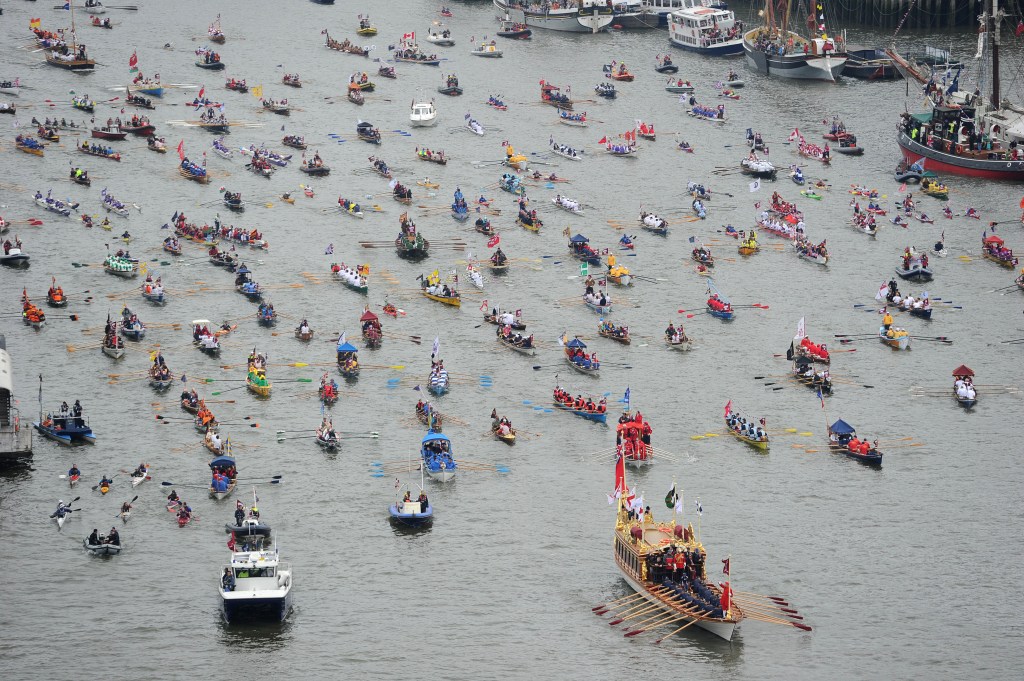
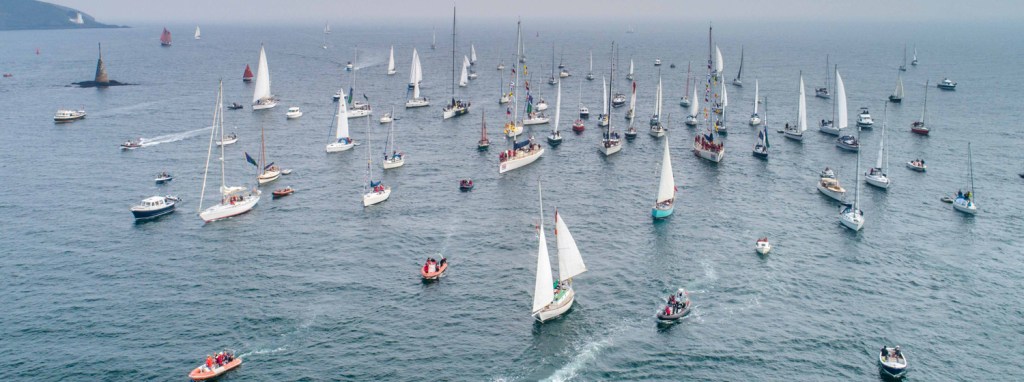
To take volunteering as an example, there is not just one thing that creates success. Mutual Aid Groups (MAGs) were and are amazing but the areas with greatest effectiveness were where when MAGs, community organisations and local authority schemes were able to join together. I have previously described my armada analogy to describe how the different sized boats of MAGs, charities, local authorities and central government aligned to meet the needs of the pandemic. It is not sufficient for these boats just to be going in the same direction, they need to be coordinated.
The Covid-19 response showed how much can be done and at considerable pace when we collaborate. A key component to building back better is for this collaboration to continue, to achieve that we need, and the government as well as local authorities need to commit to collaboration with our sector. This is essential.
Kruger Report
Kruger Recommendation 1: New official measures to understand and track the economic and social contribution of civil society
YES, YES, YES. We need this. Like, today.
Danny makes it clear we do not have good or sufficient measures of the economic and social contribution made by civil society and argues in a compelling way that if we could better to do this, then greater value and importance would likely be given to the sector. I wholeheartedly agree with this and believe greater investment in the sector will come if we can more accurately understand its impact and contribution. All governments talk nicely about wanting to support our sector, but this often feels paternalistic and that we are a ‘nice to have’ sector rather than essential part of our society and economy.
The report clearly demonstrates that Danny clearly understands charities and the sector. His report details how badly our already struggling sector has been hit by Covid-19. He uses evidence from the Charities Finance Group that estimates charities will lose 24% of income this year or £12.4 billion, with the highest losses to be felt by small charities. He states that the Treasury awarded a £750 million grant to the charity sector.
As welcome and grateful as the sector is, it is only 6% of what is needed. [Note: that is using US version of billion; do we actually use the UK version of billion as then it is only 0.006%? If anyone can educate me here, I will be grateful. My humble charities have never had to deal with billions, sadly.]
Danny correctly says, ‘if we are to maintain the social sector’s role in the ‘recovery’ phase, more [financial] support will be needed.’ Although his report offers some potential mechanisms to generate more income for the sector, these suggestions are, however, not ‘sure things’ and rely on a lot of ‘ifs’ and ‘maybes’. Even if these suggestions were to be successful, they will not plug the £11.65 billion gap he identifies that the sector needs. The report does not state that the £750 million awarded has not yet been fully distributed to the sector. It is estimated that only 50% of this has been awarded in 5 months with NPC’s article ‘how much government funding has the charity sector really received’, offering good detail on this subject. This recent article in The Independent also highlights how difficult things are for the sector.
Dominic’s Recommendation #1
(a) Government commits to helping to get all of the £750million already awarded out to charities and community organisations who need it as soon as possible.
(b) A commitment of more financial support to the sector.
Not in a paternalistic way, but because it makes economic sense to do so. The sector does not just employ nearly 1 million people(!) but the essential work the sector does supports people who would otherwise need support from the state which is unable to provide it. The sector brings in income from individuals, foundations, independent grant bodies and the private sector giving a huge return on investment by the government. As much as there is a positive multiplier to investing in the sector, there is a negative multiplier by not doing so. Not just economic, but a huge social impact that will cause suffering, further inequality and reduce social cohesion.
Kruger Recommendation 3. Negotiation with Big Tech firms to finance and co-design new, non-proprietary digital infrastructure for communities
Danny writes, ‘Big tech should be persuaded to provide, for free, the wiring of our social infrastructure. They could contribute expertise and resources to the challenges of data, referenced above; they could help with the digital innovations that are connecting volunteers and funders and charities …; and crucially they could support the mission to get the digitally excluded online. They should do this as benefactors, not suppliers; we need non-proprietary systems, with no access for the benefactors to people’s data.’
For many years I have been working with large corporations to encourage them to support communities through volunteering and related activities. I believe there is a real appetite for them to get more involved, but it needs to be well-thought through. If you can match the needs and benefits of communities with the community and social responsibility goals of businesses, which should be possible, then real progress can be made and with lots of win:win outcomes.
On technology, there are definitely opportunities, whether it is the ‘volunteer passport’ system that Danny proposes (see below) is very much up for debate. Nevertheless, if our sector can agree on a clear approach it will make it a lot easier to achieve this objective.
Social Value
Kruger Recommendation 4 – A new commitment to ‘social value’ commissioning, considering the whole of government accounts rather than a single budget
Danny accurately points out the procurement policies although well intentioned are part of the problem and, ‘this guidance quite properly seeks to ensure taxpayers’ money is spent efficiently, and without the opportunity for corruption. Sadly, these imperatives lead to two negative syndromes which afflict public sector commissioning: highly bureaucratic processes, and a tendency to award contracts to large corporate providers who do not necessarily offer the best work for the public but do offer the least risk for the commissioner. Lip service is paid to the need for a plural supply chain with opportunities for civil society organisations to deliver work, but in practice this rarely happens.’
He is 100% right on this. He is also absolutely correct that this situation needs to change. He does not offer huge detail on exactly how and I think because he knows a colleague, ‘Claire Dove, the Crown Representative for the Voluntary, Community and Social Enterprise Sector is working with government to ensure better contracts through a new Social Value model.’ On same day as the release of Danny’s report, there was an announcement by government of ‘New measures to deliver value to society through public procurement’.
We are moving in the right direction, but I fear these new measures will not be enough.
I have a simple and easy recommendation for social value procurement that will make a huge difference at national and local government level.
Dominic’s recommendation #2 – To evidence how businesses will deliver social value priorities they will need to demonstrate written support from the voluntary and community sector.
This will pro-actively encourage businesses to contact, partner with and support voluntary and community sector organisations who are tackling social priorities. The knock-on effects of this one simple measure will be hugely impactful. Not only will contracts actually deliver on social value, but the process of working together will mean businesses will have better understanding of all sorts of social issues in the area they want to work in. It will lead to productive partnerships between the private sector and the voluntary and community sector. I like the fact that Danny very much sees businesses as part of the term civil society and this measure will really enable for civil society to expand through more involvement from businesses.
Volunteering
Danny writes, ‘The pandemic has shown that our communities have an enormous capacity for action: every neighbourhood has latent reserves of manpower, expertise, compassion and wisdom that can be deployed to improve local life for everyone.’
As already stated, I am more critical of the precise recommendations around volunteering. I think the overall intentions are good to make it easier for more people to contribute to society and communities and very much agree with the high-level principle.
As an ‘expert’ on volunteering, I feel I am in good and fair position to offer criticism, but I stress this is always meant to be constructive and even though the below may seem like I think Danny is wrong in a number of areas, these are mainly on the execution and suggestion implementations to reach his goals. Therefore, I do not think we should abandon or dismiss these suggestions but we take the higher-level objectives that we can agree on and say, let’s do it a different way.
[Note: always feel describing yourself as an expert makes you sound pompous and supercilious. Also, just using the word ‘supercilious’ makes you sound supercilious. I digress.]
Volunteer Passport System
Kruger Recommendation #8 A Volunteer Passport system to match the supply of and demand for volunteers, with options to: join a new National Volunteer Reserve to help with future emergencies and with environmental projects; deliver ongoing mutual aid to people in crisis; fulfil formal public service roles such as magistrates or charity trustees.
In more detail he states that the ‘Government should build on the voluntary spirit of the Covid-19 crisis to create a Volunteer Passport system. This should be a non-proprietary system held in trust for the public, not provided by a commercial operator. It should be overseen by an independent Board or Commission, headed by a respected civil society leader. It should be designed in public, with as much consultation and collaboration as possible, with a clear imperative to break the long tradition of central IT-led initiatives becoming clunky, bureaucratic failures.’ As stated above, Danny spends a lot of the report arguing for more local power and control and so it was disappointing to see this suggestion of a centralised government-controlled volunteer passport system.
I can understand why has come to this recommendation, but I know if he had been given more time to produce the report to discuss and consult on his suggestions that a different recommendation would have been made.
It should also be noted that the term ‘Volunteer Passport’ can and has been used to mean slightly different things in different settings. There are lots of areas that have or intending to implement a volunteer passport of some sort. For example, in Derbyshire there is a Volunteer Passport scheme that consists of standardised training, ‘a countywide short training course exploring key areas all volunteers need to be aware of.’ In other areas the volunteer passport schemes are more focused on vetting and speeding up the onboarding process of volunteers. In addition, some schemes will enable the volunteer to have a virtual passport where their volunteering history can be shown and recognised.
I’m currently working with some great VCS partners and the NHS in the 5 boroughs of North Central London (NCL) to look at ways to develop and integrate NHS/health volunteering. Earlier this month we looked at Volunteer Passports in more detail at the NCL Volunteering PLUS Network meeting. Helpforce, who ‘work with hospitals and healthcare workers to accelerate the growth and impact of volunteering in health’, kindly presented to help set the context and understanding of what is needed for a Volunteer Passport scheme. It was extremely helpful and the key points they raised to consider thinking about in relation to implementing a volunteer passport system were:
- The problem is not technical or digital
- The problem is systemic
- The solution is strategic
- The problem is about sharing information
- The solution is a process not a thing
They stated that elements of a volunteer passport process include common approaches to validating identity, recognition of training, DBS and shared approach to risk management.
I explain this detail as I am not sure, from what he has written, Danny has fully understood what a Volunteer Passport scheme really is and what is entailed to achieve it. The way he described the scheme throughout the report feels very much like he is talking about a national government-run online volunteer brokerage scheme, with volunteer passporting being a part of this. He highlights the success of the NHS Volunteer Responder Scheme, run by the Royal Voluntary Service, as an example of why this suggestion should work.
The short time Danny has had to produce his report means that he has not understood the detail about these schemes and why they will not work, or at least not be as effective, in the way he has suggested. However, any schemes and mechanisms that make it easier for people to volunteer are definitely worth looking at.
Dominic’s Recommendation #3 – Agreement of Government and the voluntary and community sector to work together to look at mechanisms such as volunteer passports that make it easier for a volunteer to start volunteering and recognise other volunteering they have carried out.
I also need to explain more why a centralised government volunteer brokerage portal/database will not be as successful as Danny believes. He uses the success of the NHS Volunteer Responder Scheme as his main reason for arguing his case for developing further this type of approach. However, the Volunteer Responder Scheme has been successful as it has focused on a small number of fixed volunteer roles that can be carried out on an ad hoc basis. This suits the large amount of informal volunteering required during this crisis but will not be so suitable for the significant level of formal volunteering that is required to help the thousands of great charities and community organisation keep providing their services.
As great as the Volunteer Responder Scheme (VRS) has been, it did not provide all or the majority of help needed. It was, as it was always meant to be, a complimentary service to local support. Although it is complimentary, it is not joined up or integrated to local support despite many areas trying to make this happen. As just one example, I know a Volunteer Centre that asked for a relevant local message to be sent to the NHS VRS volunteers registered in their area but was told it could only go in their newsletter that would go to all the volunteers across the country. I write this not to criticise the scheme but to highlight why centralised schemes do not often work well in local environments.
Rather than a centralised government run volunteer brokerage service, why not enhance and empower local volunteering infrastructure which have been an essential part of the Covid-19 pandemic response. Not once in the report are Volunteer Centres mentioned. This is a serious omission.
Volunteer Centres have, in varying ways, been important players in the response, mostly behind the scenes, leading on recruiting to local volunteer response schemes, supporting and advising Mutual Aid Groups, helping to put together guidance to help volunteers carry out their work in a safe way (both physically and safeguarding) and communicating and engaging with volunteers throughout of ways to support the community. They have collaborated and worked in partnership with and supported local authorities, funders, charities, community groups and residents.
Dominic’s Recommendation #4 – Empower and enhance local volunteering infrastructure to better able to mobilise, broker and support volunteering in all of its forms, both informal and formal in both crisis and non-crisis times.
National Volunteer Reserve
As part of his recommendation #8 on developing a volunteer passport system, Danny writes, ‘Volunteer Passport holders should be invited to join a National Volunteer Reserve.’
‘The National Volunteer Reserve should be placed on a statutory footing, with an annual declaration by Government departments of the people and capabilities needed during ‘business as usual’ and in the event of an emergency. The VCS Emergency Partnership is designed to identify local and regional needs and this work should feed into the process. The relationship between the Reserve and Government should be overseen by a formal Whitehall system designed to ensure early warning and good management.’
This is another recommendation that sounds perfectly sensible but the actual practice of it is very different. I have first-hand knowledge and experience as the charities I run delivered the Nesta & DCMS funded CAMERA emergency volunteer programme based on the learning from Grenfell and the evacuation of the Chalcots Estates. What seemed a logical and helpful programme hit many hurdles to actually implement.
The difficulty here for any sort of emergency volunteer programme is that not all crises are going to be like Covid-19 or Grenfell. For Covid-19 support from people across the country, in every community, to help others was needed, but for an emergency like Grenfell it is commanded and controlled by the authorities and so local people will unlikely to be involved as they are not known or trusted. Our CAMERA Emergency Volunteer programme was designed to enable local people to be trained in emergency response to add value to official emergency management response. Although there was high-level buy in by local authorities, the emergency management teams themselves were resistant to involving volunteers, citing safeguarding and DBS requirements as one of them, e.g. we were told that all volunteers at an emergency rest centre had to have an enhanced DBS, even though this would not be possible as the role is ineligible.
I think there is definitely something that can be done around volunteer response but based on my experience a national centralised approach will not be very successful. As we experienced obstacles trying to implement this locally then perhaps a regional approach will be more appropriate? What would be very helpful would be to have some agreed guidelines across the country to involve volunteers in different types of emergency responses. Once we have that, then we can understand better whether a local, regional or national approach will be most appropriate.
Dominic’s Recommendation #5 – Develop nationally agreed guidelines for how volunteers can support emergencies
Older People
In his report Danny identifies older people are and will increasingly be an asset to harness to add more volunteer support to where it is needed. He writes, ’as more people live longer, older people will constitute the most extraordinary asset for our society. Andy Haldane predicts a doubling of surplus hours by 2050 due to people living healthier lives.’
He goes on to recommend that ‘public services should encourage this by helping people stepping down from professional roles – retiring from a career in education, the police, the NHS or local government, for instance – to take up voluntary responsibilities or formal statutory roles (see below, Public service).’
This idea was talked about a lot in our sector 2-3 years ago. Looking at it crudely, it could seem a case of just thinking we need more volunteers and because there are increasing numbers of older people supposedly who have free time so let’s try to get them to volunteer. This is, of course, wrong.
A lot of time and research has gone into this issue and I have found the Centre for Ageing Better very helpful in this regard. Two key points I have picked up from others are:
- Older people do not have lots of ‘spare time’ and can be very busy with supporting their family in different ways, have other activities they want to do or do not want to do work-like activity now they are retired
- The best way to get more older people to volunteer is to get younger people to volunteer as volunteering is quite a habitual activity, so if more younger people volunteer, there is an increased chance they will volunteer when they are older.
Business Volunteering
I absolutely agree with Danny’s desire to get more business volunteers involved in our communities to tackle social issues. I do not necessarily agree with his suggested method, but this is definitely an area to take forward. He wrote in his report, ‘there is a major role for business volunteers in the future model. The landscape of business and charity engagement is fragmented, and the Volunteer Passport could help align firms around meaningful local needs, driving up employee engagement and delivering great value for society.’
He is totally correct that the landscape of business and charity engagement is fragmented, but for reasons already explained, the Volunteer Passport/Brokerage system is not going to be the best way to do it. I helped set up and run a social enterprise whose entire social mission is to help businesses to support the community through volunteering. I also helped set up the London Employer Supported Volunteering Network to try and join up the fragmented work that takes place.
I believe there is a place for more automated self-service type models to connect businesses to volunteering opportunities, but this is only part of much larger area of development. If we are going to achieve a step change in activity, we need to organise the voluntary and community sector to pro-actively and very clearly design and promote specific ways businesses can support the community. At the moment, most activity in this area is carried out reactively, e.g. a business contacting a charity saying it has “30 volunteers available on the 15th, what can we do?” If we reverse this communication and promote different mechanisms of how businesses and their employees can help tackle social priority issues, we will lead to more joined up and impactful work. There will also need to be brokerage support to help businesses to match their community/social responsibility goals with needed volunteering opportunities.
Part of this work will also necessitate the voluntary and community sector adapting to offer more informal, flexible, ad hoc roles. Although some VIOs have started to do this, the vast majority of the sector is not yet ready and will need a lot of tailored support to enable this as each charity will be different.
Dominic’s recommendation #6 – Produce a plan, led by the voluntary and community sector, with detailed recommendations to develop a coordinated business volunteering support
Dominic’s recommendation #7 – Support local volunteering infrastructure to pro-actively help VIOs to adapt to offer more informal volunteer roles
Trustees
Danny very correctly identifies that we need more and varied people to become Trustees. He states, ‘there is also a growing need for people to take formal positions as school governors and charity trustees. As with magistrates, we need more working-age trustees and governors, and more from less advantaged backgrounds. Government should consider a requirement for employers to give time off for trustee and governor work.’ I very much support and encourage any recommendation that helps achieve more people becoming Trustees. Trustees are such a vital but under-appreciated volunteer role and, in my opinion, are the best volunteer role there is.
Danny, also suggests and details why this a controversial suggestion, ‘it should also actively consider allowing – as a matter of course rather than by requesting an exemption from the general ban – charities to pay trustees for their time, if they wish to do so.’ I am not so sure about this, but I think it is worthy of discussion and review. If it helps more people who would find it difficult to give the time to become a trustee that also encourages more diversity of boards of trustees, then I think this could be an acceptable exception?
Dominic’s Recommendation #8 – National campaign to promote the role of Trustee along with a review and discussion of mechanisms to improve diversity of boards.
Young People
In his report, Danny suggests that developing more youth volunteering will help tackle the estimated 1 million unemployed young people that will arise due to Covid-19. He recommends a national programme of volunteering to be added or embedded into the government’s new Kickstart scheme which is designed to support the wages of 350,000 young people.
He suggests a programme called ‘Service Kickstart … within the Kickstart scheme designed to deploy up to 100,000 young people on a range of social and environmental projects. Young people would be paid via Kickstart to do this work, which could be full-time or (for those in training or employment) part-time. … Projects would be organised by civil society working with local authorities and businesses. They might include volunteering with local schools (helping younger children with mentoring, academic catch-up, sports or playtime); visiting hospitals and care homes; taking part in environmental clean-ups or biodiversity projects; restoring dilapidated youth clubs and community centres; retrofitting and insulating homes, schools and care homes; producing public art; gardening and landscaping public land; and more.’
Again, another sensible sounding suggestion but I think the detail and practicalities of this will mean it would not be very successful. I recognise this is just a high-level suggestion, of course, but my main concerns are:
- The volunteering does not sound very much like volunteering as the individual is financially supported to do this and does does not have free choice to do this or not
- Will young people want to join a national volunteering service? My feeling is that this will not be popular and there are other ways to be looked at to encourage young people to volunteer
Philanthropy
Kruger Recommendation #17 Options to boost philanthropy, including civic crowdfunding, and social investment
I wholeheartedly support Danny’s recommendations around increasingly philanthropy and this should be an easy to do quick win. He very rightly states that ‘the wealthy could give more, and the very wealthy could give a lot more. Of those earning more than £250,000, two thirds make no donations to charity whatsoever. of giving.’
He suggests there should be a ‘campaign for the world’s super-rich to invest their philanthropic funds in London and benefit from the infrastructure of expertise and experience there. One way to attract this capital would be to devote a fraction of the UK’s international development budget to a match-fund scheme, multiplying the budget and tying philanthropy to our development strategy.’
He also suggests looking into new platforms and mechanisms for giving. He states, ‘already, people on low and average incomes give more as a proportion of their wealth than the rich, so there can be no criticism of people on ordinary incomes for their levels of giving. Nevertheless, the government should support new digital platforms to stimulate giving across the population. … Government should explore the option of a new national civic crowdfunding programme.’
Funding
Kruger Recommendation #18 A new £500m Community Recovery Fund, financed by the allocation of the dormant National Fund, for charities and community groups supporting the transition from the ‘response’ to the ‘recovery’ phase
Kruger’s suggested Community Recovery Fund (CRF) ‘would build on the £750 million in emergency funding provided during the ‘response’ phase of the crisis in April. It would help established organisations with a real contribution to make to the ‘recovery’ phase weather the storm (radically reduced fundraising and radically increased demand for their support); and it would help new and emerging organisations, including those mutual aid groups which wish to transition to ongoing charities and community businesses.’
He thinks the money from this could come from the unused National Fund. He states, ‘the CRF would ideally consist of £500 million of public money. This is the present value, or thereabouts, of the National Fund, … government should recognise that the National Fund is a charitable asset and that it should be applied to support civil society. …. Government should appeal to the trustees to hand over the National Fund to meet the exigency of national recovery.’
I have no idea how feasible this actually is, but it would be very helpful to the sector if it could.
Kruger Recommendation #19 Consult on the use of the £2bn+ which will shortly be available from new dormant assets: options include a new endowment, the Levelling Up Communities (LUC) Fund, for perpetual investment in long-term, transformational, community-led local projects in left-behind areas
Kruger recognises ‘our communities need a better model of social infrastructure and neighbourhood organisation than they had before the virus struck. This should include a far greater degree of local empowerment, which I address in the next section. To complement this transfer of power I propose a major new endowment – the Levelling Up Communities (LUC) Fund – to provide a permanent source of income for the UK’s communities.’
The money for this fund, Danny recommends, should come from the estimated £2billion ‘sitting in dormant insurance accounts and other financial products. Negotiations are underway to release this money in line with the scheme that so far liberated £1.2 billion from dormant bank accounts.’
Again, I do not know how feasible this actually is, but it could be very helpful for the sector.
Conclusion
This was actually meant to be a short blog post.
The length and detail of this response shows, despite criticisms outlined, that there is a lot to engage with in this report. I am currently part of a National Volunteering Cell Task & Finish Group and although there are different opinions, we agree that is wrong to go through the precise details of Danny’s recommendations but instead embrace the spirit and high-level intentions of the report and offer an open collaborative hand to discuss further with him and Government.
The big message I take away is that Kruger thinks the work of charities should be valued higher, the sector should have more money, there should be more and easier ways to volunteer, businesses are and should be increasingly part of civil society, social value procurement should be far more effective and we should value and put more importance on local power and spaces. That is great! Let’s run with this, work together and make this happen.














 Dominic Pinkney's World of Volunteering