Community CVS the First Volunteer Infrastructure Organisation to Obtain the Lead Volunteering Organisation (LVO) Quality Standard

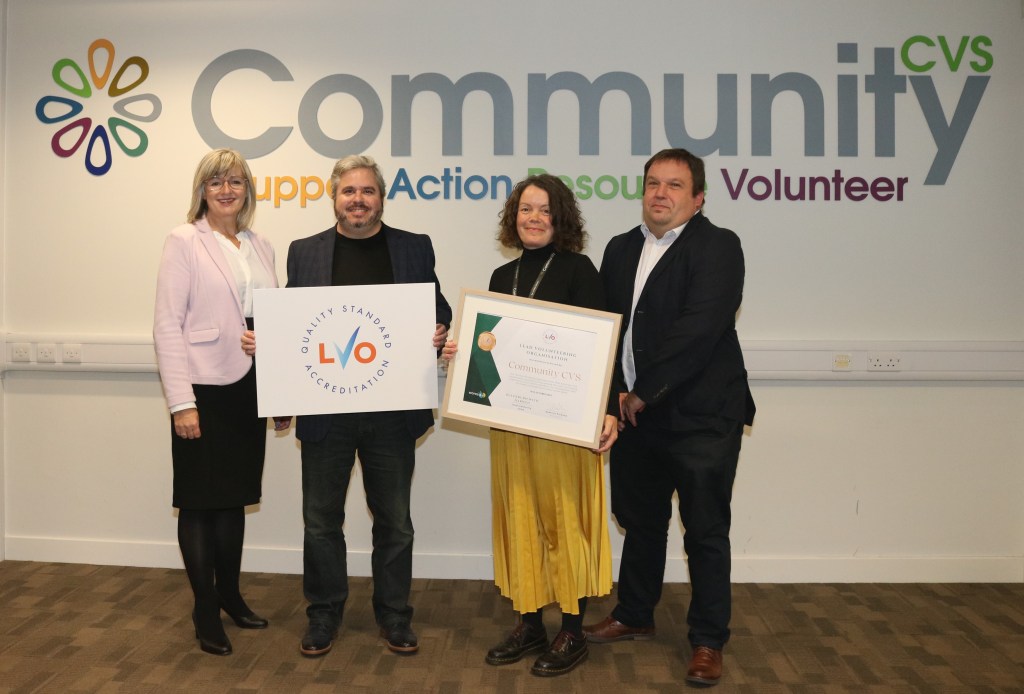
Presentation of the LVO Award to Kate Lee and the fantastic team at Community CVS

It was a proud moment for me to present, this week, the very first recipient of the new quality standard, Lead Volunteering Organisation (LVO), to the very deserving Community CVS who serve the area of Blackburn and Darwen.

The LVO is a new quality standard for modern volunteer infrastructure organisations who want to demonstrate to funders, stakeholders, partners and beneficiaries the important role they place in leading volunteering in the area they operate. It has been created by not-for-profit Works4U who are also launching a quality standard for businesses, Employee Volunteering Accreditation (EVA).

As someone who manages two volunteer infrastructure organisations in London, I have been frustrated for many years that there has not been a quality standard that meets all my needs. I want a quality standard that:

  • would genuinely impress funders and I could show it off to partners and beneficiaries
  • was exclusive for my area, meaning no other organisation than mine could hold it
  • would allow me to adopt whatever brand I chose for my organisation
  • was affordable and value for money
  • was flexible, recognising that there is not one single model of what volunteer infrastructure is
  • had robust assessment processes but was not too onerous a task to carry out
  • would be supported by an organisation who genuinely wants to see my and other volunteer infrastructure organisations be successful and recognised for the great work they do with little resources

Well, this now exists with Lead Volunteering Organisation (LVO). This is what I wanted for my organisations and so it seems many others do as well. Quite a few organisations are going the assessment and moderation process at the moment, but the first to complete and achieve the award is Community CVS.

Community CVS, set up in 1986, exists to promote, develop and support voluntary and community action in the Borough of Blackburn with Darwen and across Lancashire. It is committed to delivering its services to organisations and residents to the highest of standards and to help demonstrate that it applied to be assessed for LVO to clearly show its role in leading and developing volunteering.

Kate Lee, Volunteering Manager from Community CVS stated, ‘We are proud to have obtained the new LVO quality standard for developing and leading volunteering in Blackburn with Darwen. We have over 20 years of experience and knowledge of supporting volunteering,  and this award provides assurance of our ability to mobilise volunteers, connect people to where they are most needed in their neighbourhood, support new groups to get everything they need in place to involve volunteers,  and improve the quality of the volunteering experience for all in Blackburn with Darwen.’

Community CVS CEO Garth Hodgkinson said, ‘Achieving the LVO Quality Mark demonstrates the quality of our work in leading and developing volunteering in the borough.  It shines a spotlight on our knowledge and connection with the voluntary and community sector in Blackburn with Darwen and our key role in connecting people together, to communities working together to tackle adversity, and on our development of strong partnerships with Blackburn with Darwen Borough Council, NHS and other key strategic partners.   Community CVS will continue to deliver high quality services to help grow resilient communities and enable them to thrive– something we need now more than ever.’

LtoR: Cllr Julie Gunn (Deputy Leader of Blackburn with Darwen Council), Dominic Pinkney (Me), Kate Lee (Volunteering Manager for Community CVS), Garth Hodgkinson (CEO, Community CVS)

Cllr Julie Gunn, Deputy Leader of Blackburn with Darwen Council, said, ‘In Blackburn with Darwen, we are incredibly lucky to have a wealth of people who give their time freely as volunteers to help others. The role of Community CVS is vital in connecting volunteers to the right opportunities to truly make a difference. I am pleased and proud that Community CVS has been recognised in this way. I’m delighted especially that Community CVS being the first organisation nationally to gain the LVO Award puts the borough on the map as a place where volunteering truly matters and thrives.’

Works4U’s recent report ‘Monetary Value of Charity Trustees‘ shows that the economic value of all volunteering is £324 billion, far higher than has been previously considered. This means the role of volunteer infrastructure organisations to lead and develop volunteering in the area they operate is far more important than has been realised before. It is hoped that the LVO Quality Standard will help volunteer infrastructure organisations demonstrate their important role to decision makers.

To find out more about LVO you can can download the overview from the Works4U website or view here.

The Story behind the Game-changing report on the Monetary Value of Trustees

So… I’ve written a report. But I didn’t mean to.

What I set myself as a 15 minutes task ended up being a 58 page report (don’t worry, there are lots of images) and I have not dared to calculate how much of my spare time this took.

I run two volunteer centre charities and so have more than enough to do without giving myself extra work. Also, is the world crying out for yet another report? Nevertheless, I realised this was something important and that it was an opportunity to scream out what so many in the voluntary sector know and feel but in terms that people outside the sector can understand and relate to.

The 15 minutes task I set myself was to go online and find a formula so I could calculate the monetary value of trustees in the London Boroughs I work in (Hammersmith & Fulham and Camden). I could use this data to help promote just how important and valuable this under-appreciated volunteer role is. A quick look around my blog and you will see I am strong advocate that trustee is one of the best volunteer roles there is.

All I needed was the wage rate of an accepted comparator job role and find out the number of charities in each borough. That shouldn’t be too hard should it? National organisations in our sector or government or others must have looked at this and established a formula to use?

Nope.

This was taking more than 15 minutes and I was getting frustrated. In terms of actual calculations the best I could find was a 2017 ‘Taken on Trust: awareness and effectiveness of charity trustees in England and Wales‘ report produced by Charity Commission and partners. When I say this was the best I could find. It was the only thing I could find.

This used average national wage as a comparator. I was disappointed. This felt like a cop out. It felt like it was chosen just because there is reliable and regularly updated data for this measure and that it is a conservative ‘safe’ comparator that no one will accuse of being an over-estimation. However, as well as being a comparator that massively under-estimates the value of trustees it is not a valid one as the average national wage has absolutely nothing to do with the actual role of being a trustee? The two are not related.

Other research, dating more than ten years ago, referenced using ‘Senior Manager’ as an acceptable comparator?! What??? Could this be more vague? Senior Manager in what sort of organisation? Which sector? How senior is senior? This felt very weak, as if it was chosen to show that the trustee role has more importance than the average job, that it has responsibilities, but it is so vague how do you pick which actual Senior Manager role to use? Also, most importantly, a Senior Manager does not have the same level of responsibilities as a charity trustee. A Senior Manager is not legally responsible for the organisation they are a Senior Manager for.

The 15 minutes I set for myself for this task had ended hours ago.

I wasn’t going to let this lie. This sort of data and calculations should exist and if it didn’t, then I was going to have to create it myself.

naïveté, that fabulous quality that keeps you from knowing just how unsuited you are for what you are about to do.”

Steve Martin

My research continued at length and finally I found a reasonable and authentic comparator for the volunteer charity trustee role. I just needed then to find out how many charities were in a particular local authority area. The Charity Commission provide data on this but they told me it is imprecise.

I now realised why this area had not been tackled much before … it was difficult. However, I was determined and as long as I was open about my assumptions and calculations then authentic results could be obtained. All calculations in this area are imprecise and estimates, but as long as that is recognised when analysing and making conclusions then it is perfectly valid.

Carrying out this research not only led to an authentic calculation of the monetary value of trustees, but it also enabled, through extrapolating the results, an indicative value calculation of all volunteering. Even accounting for margins of error, volunteering is clearly of more value and importance than had been given credit previously. If government were aware that volunteering is just as important as all manufacturing, what would it do differently?

I was also aware that I might have massive bias. I run two volunteer centre charities and it could easily be seen that I am trying to inflate the importance of volunteering for the benefit of my own organisations. This was not and is not my agenda, I just wanted to spend 15 minutes to find an acceptable formula to show how important trustees are through a monetary value that people outside my sector can relate to.

To help combat any bias, I sent the first iteration of my report to over 30 people across the private, public and community sectors. These kind, wonderful and expert people gave up their time and came back to me with their comments, suggestions and challenges. These were extremely helpful and their comments helped to refine the formulas and assumptions used. Therefore, I think I can legitimately say I have been pro-active to counter any bias I might have in producing this report.

The results of the calculations carried out surprised me so they may surprise you too. This led me to add a page, ‘But the numbers are too big?’ so that readers can rationalise and understand why the numbers are as large as they are. It is also noted in the report that I calculate the monetary value, as in the financial equivalent job role, and not the full economic value which will be much higher as it includes the add on multiplier effect of the volunteering itself which can benefit the person and the wider community.

This report is presented by Works4U, a small not-for-profit social enterprise that punches far above its weight in the world of employee volunteering. It does not have a Comms team or a PR agency to support it. Any help you can to like, comment and share the report so it can reach as many people as possible will be greatly appreciated. By sharing it there is also the tiny possibility you might change the perception of decision-makers about the importance of volunteering.

I hope you enjoy the report:

Monetary Value of Trustees 2023‘ This links to a page on the Works4U website where you can view or download the report.

9 Expert Tips for Developing an Employee Volunteering Programme

Employee volunteering experts Works4U have produced a free guide for businesses to help them establish and develop successful impactful volunteering programmes within their organisation.

Not-for-profit social enterprise Works4U was founded in 2009 and they have helped hundreds of businesses with their corporate volunteering programmes. If you are looking to develop your employee volunteering programme and want to learn from the experience of others, then this simple and practical guide will help you be successful and avoid common mistakes.

The guide of expert tips is a must for anyone involved in an employee volunteering programme. Works4U’s recommendations will help save you money, better engage your staff and develop your business.

An effective employee volunteering programme will help you demonstrate your CSR and ESG credentials as well as many other business benefits.

Here is a sneak preview of the guide that gives details of 9 expert tips to help employee volunteering professionals:

1. Culture first, technology second – The number one reason that employee volunteering programmes get limited traction or fail completely is due to a technology first or technology led solution.

2. Walk before you can run – The second most common reason employee volunteering programmes struggle to get off the ground, is when companies get too ambitious in the early development.

3. Quality over quantity – With employee volunteering programmes, measuring volunteer hours is vanity, volunteering culture is sanity and impact is king.

4. Engaging with community organisations – An area that often causes issues for companies is engaging with charities and community groups.

5. Recognition of volunteers – It is standard volunteer management best practice to recognise the work and contribution of volunteers. However, many businesses fail to do this.

6. Don’t forget the business reasons for having an employee volunteering programme – If a business is implementing an employee volunteering programme as a ‘tick box exercise’ or views it as a ‘nice to have’ then its success and impact will be limited. Employees will realise pretty quickly if a business does not really have its heart in such activity.

7. The right personnel – many organisations fall down in this area as either they have not recognised their strengths and weaknesses or their set up is not right.

8. Keeping volunteering voluntary – Another area that companies fall foul of is to make participating in volunteering events mandatory or obligatory.

9. Don’t deviate – Even if you know all the good practice in delivering successful employee volunteering programmes, sometimes it can be difficult to resist the influences and pressures from both within and external to the business that may cause your programme to falter.

To download a copy of the full FREE guide, go to Works4U’s webpage.

Works4U are able to offer this highly valuable guide for free as part of their social mission to lead the development of impactful employee volunteering in the UK. Works4U are also launching the world’s first employee volunteering quality standard (EVA): https://www.evaqualitystandard.com/

Is Volunteering Dying?

If this sounds like one of those deliberately provocative ‘clickbait’ headlines, then I’m sorry to have to say this is a real question being asked in the voluntary and community sector. Only this week I got an email from someone struggling to recruit volunteers for an event who told me, ‘volunteering is a dying trait’.

Without volunteers there is no voluntary sector.

This is, of course, the bleeding obvious. It is so obvious, it seems, that it is completely forgotten and taken for granted.

Volunteering is the lifeblood of the voluntary and community sector. From informal gifts of time through helping a neighbour or at a community event through to formal roles such as Trustees, volunteering is ESSENTIAL to the sector functioning.

If volunteering is dying, then the result is the sector is dying. If the sector is dying, then communities are weakened and unsupported increasing demand on public services that are either already at capacity or do not exist as that is what our sector does. Bottom line, if volunteering is dying then everyone should be worried.

All across the UK, towns, cities and rural areas are reporting significant drops in the levels of formal volunteering:

  • Volunteer Now published their findings on the impact of the cost-of-living crisis on volunteering in Northern Ireland in December 2022 stating, ‘The emphasis and frequency with which volunteer recruitment was raised by interviewees was concerning.’ They also report the negative impact this is having on the mental health of volunteer managers.
  • Volunteer Scotland has been carrying out some great research into volunteering and how the cost-of-living crisis has impacted Scotland’s volunteer involving organisations (VIOs). Their February 2023 report has some important analysis and I would direct readers to the Key Findings on page 12 of their report.
  • NCVO, the umbrella body for the voluntary and community sector in England, in December 2022 also reported a lot of its members are having issues and problems recruiting and retaining volunteers.
  • I co-chair the London Volunteer Centre Network and members across London are reporting issues around volunteer recruitment and retention. The Hammersmith & Fulham Volunteer Intelligence Report (Mar 2023) also highlights that the biggest issue affecting local VIOs is recruiting new volunteers.

This is not meant to be an exhaustive list of evidence, but hopefully enough to convince that there is a real decline in formal volunteering and that this is causing real problems for charities and the communities they serve.

The cost-of-living crisis is clearly a large contributing factor, but to think volunteering issues will disappear once that has passed is to misunderstand the situation.

Volunteering has serious structural and systemic issues which have been exacerbated by the cost-of-living crisis but will remain, or be worse, once the crisis over:

  1. Trends for volunteers and VIOs moving in opposite directions – this has been happening for a few years and was accelerated by the pandemic. VIOs are increasingly more safeguarding conscious with long on-boarding processes to train and support volunteers to carry out their roles. As a result, they are naturally keen to have volunteers who will commit to giving significant amount of time over a long period. Whereas those interested in volunteering increasingly want to do it on their terms, when it is convenient for them, on an ad hoc basis and as soon as possible.  Although VIOs are making some efforts for more flexible volunteer roles, they have a long way to go.
  2. Post-pandemic volunteering is different. As well as the cost-of-living, there are many factors that have impacted volunteering, such as:
    (i) Many older people who volunteered in-person have not returned to their volunteer roles;
    (ii) Perception that the pandemic is over and so volunteers not needed so much;
    (iii) Fatigue and burnout of volunteers who have already given so much of their time;
    (iv) Desire to volunteer remotely and/or less inclination for in-person volunteering
  3. Lack of funding to support volunteer programmes – to manage effective volunteer programmes that recruit and retain volunteers well you need good volunteer management resources. The economic squeeze of VIOs over the past 10 or more years has led to a reduction in these resources and, in many cases, managing volunteers is tacked onto existing roles rather than it being a dedicated roles.
  4. Voluntary sector infrastructure funding has reduced in real terms. The Feb 2023 360 Giving report highlights how VCS infrastructure funding, in the last 12 years has reduced, in real terms, compared to the rest of the sector.
  5. Weak national bodies – the national agencies which represent and champion volunteering and volunteer infrastructure do not have the clout and influence to persuade national and local government to invest in this area.
  6. The economic value of both volunteering and the infrastructure needed to keep it prospering and responding to needs is not understood. Obviously, local authorities and funders do understand it has a value, but they do not understand what they receive, in monetary terms, for their investment. Because of this, investment has reduced and, in some areas, has ended (for example, very sad to hear of the closing of Volunteer Centre Swindon)

The Value of Volunteering?
If we can solve the issue of understanding the value of volunteering this will go a long way to help solving the other issues.

There is an often-used quote in our sector by Sherry Anderson, “Volunteers are not paid; not because they are worthless, but because they are priceless.” As much as I love the sentiment behind this, it is also extremely unhelpful as we live in a society where only things with a clear economic value are supported, developed and invested in.

The benefits of volunteering for the individual and communities are, I hope, well known. As well as the actual impact of the volunteering, for individuals, volunteering helps mental health, builds social and professional networks, develops skills and is fun. For communities, people giving a little of their time formally or informally makes them resilient, cohesive and nice places to live. However, the economic value for these benefits is unknown.

Martin Brookes, the CEO of London Plus (which champions charities and community groups in London), highlighted a useful example that illustrates this issue in a short article ‘A better way to value and think about charities’. To summarise, it describes how volunteers from Good Gym stepped in to deliver prescriptions during the pandemic, as the private sector did not want to do this, not only did this volunteering activity not count towards calculating our GDP, it reduces it, whereas when the private sector carries this task out, it increases GDP. It is just one very real example which shows that as well as the value and impact on our society and economy of volunteering is not being measured or counted, when it does happen it can create a negative effect on the financial measures currently used.

Although the article does not mention it, as it was not relevant for the point being made, but it was the infrastructure organisation Voluntary Action Camden who facilitated the connection between the GPs/pharmacies and Good Gym who provided the volunteers. This clearly shows the benefits of infrastructure organisations, but the monetary value of this very important facilitation and brokerage is also unknown.

Therefore, those who work in the sector, whether it local, regional or national infrastructure, need to quickly come up with some measures of value to demonstrate the importance of volunteering. If we do not, then it could lead to decisions being made to stop investing in volunteer infrastructure with the inevitable consequence of having to re-establish it again later which not only costs more in the long run but takes time to do and weakens the whole sector whilst this happens.

What can we actually do?

The reality of volunteering right now in the UK is not good and looks quite bleak given the structural and systemic issues, but we are not in an impossible situation. Understanding what the problems are is definitely part of being able to create a solution.

Waiting for the cost-of-living crisis to end is not the answer. We need to tackle the issue on multiple fronts and we all have a part to play in the solution.

Showing economic value of Volunteering
Even if they are imperfect, we need to start estimating the economic impact of volunteering and volunteer infrastructure. In his article referenced above, Martin Brookes states, ‘The Law Family Commission on Civil Society offers a large number of very practical recommendations about data. They offer the prospect of improving how we measure the value and contribution of people like the runners of GoodGym in Camden.’

Young People
Pro Bono Economics wrote an article in December 2022 asking, Is 2023 set to be the year of the volunteer?’ highlighting that there could be a wave of new volunteers stating, ‘1 in 6 young people, aged 18-34, plan to start volunteering. At the time of writing (March 2023), we are not seeing a lot of this yet and some of the structural issues of volunteering, particularly lack of flexible volunteering, are likely holding this back. However, having said that, one Hammersmith & Fulham VIO reported ‘we need volunteers and have less applications from adults and more from young people.‘ So, as well as making volunteering more flexible we need to make changes so that more younger people can get involved.

Increased Awareness of Need of Volunteering
When people think there is a real need or crisis, they step up to volunteer. This has been proven. Right now, in general terms, no one really knows that there is a real need for volunteers.

Although many volunteer infrastructure organisations do very well with social media and communications, none of them have a loud enough voice for this current situation. These organisations need help from others with bigger voices such as local authorities, national bodies and the government to significantly raise the profile of the ask for volunteer support. For example, a national promotion but locally delivered would be very impactful. However, these need to be coordinated between national and local bodies to be effective as the poorly thought through Big Help Out has shown.

Local authorities can play a stronger role in amplifying the messages of volunteer infrastructure organisations and if they can work together on dedicated campaigns it can reach more people who could volunteer.

Conclusion

Volunteering is not dying, far from it, but it is injured. The need for effective healthcare, i.e. local and national volunteer infrastructure, has never been stronger.

Just a few days left – WIN £200 for a charity or community group of your choice

There are only a few days left to win £200 for a charity or community group of your choice.

As promoted by Smiley News, all you need to do is complete the very quick and easy anonymous survey about employee volunteering from not-for-profit social enterprise Works4U:

https://www.surveymonkey.co.uk/r/5R8ZBC3

Works4U is an employee volunteering specialist and the survey will help put a spotlight and focus on this underrated activity and help it to develop and be even more impactful.

So, for less than 5mins of your time, you can win some money for a charity or community group you care about AND help develop the impact of volunteering.

Eligibility:
– You need to work in the UK (any type of organisation in any sector)
– Your organisation employees 5 or more people

2022-23 UK Employee Volunteering Survey

Survey: https://www.surveymonkey.co.uk/r/5R8ZBC3

There is a big contrast in the significant level of employee volunteering activity in the UK compared to the small amount of data, analysis and research on this topic. It is actually quite surprising.

Employee volunteering specialist, not-for-profit Works4U, is addressing this large gap by launching a dedicated employee volunteering survey that will provide, perhaps for the first time, real analysis on the employee volunteering experience. Works4U will release the results of the survey in 2023 and its aim is to this annually to provide regular up-to-date analysis on employee volunteering.

Works4U will be able to report back on aspects of employee volunteering we do not currently have any proper data about. For example, on average, how much time off is given by employers to carry out employee volunteering? Does this vary by the size of organisation? How is the employee volunteering organised? How much impact did the employee volunteers think their volunteering had?

This data and analysis will give great insight into how businesses carry out employee volunteering and whether they are maximising the potential of its impact for their organisation, their employees and for the community.

It is clear to see in 2022 that businesses take far more seriously their social responsibility compared to ten years ago. Terminology in this area moving from Corporate Social Responsibility (CSR) to social or community impact with Environmental, Social and Governance (ESG) being most prevalent amongst larger corporations. Whatever the terminology is used, employee volunteering and how it is carried out is an important part of this work.

The survey is open to anyone working for any type of organisation (private, public or voluntary sector) where there are 5 or more employees.

You can view, complete or share the survey using this link:

https://www.surveymonkey.co.uk/r/5R8ZBC3

Lead Volunteering Organisation (LVO) Quality Standard is Live!

Lead Volunteering Organisation (LVO) Quality Standard from Works4U

I am proud and pleased to say the brand new Quality Standard called Lead Volunteering Organisation (LVO) is now live!

Designed by a volunteer infrastructure organisation for volunteer infrastructure organisations. To explain in other words, I have selfishly created a Quality Standard that I want for my volunteer infrastructure organisations and so it will probably be beneficial for others too.

NCVO’s announcement last year that it was no longer delivering quality standards and would be handing over VCQA to another organisation has led to many volunteer infrastructure organisations thinking about quality standards for the first time in a few years.

“What Quality Standard is right for my organisation?”

“Do I even need a Quality Standard?”

“What about the costs and time to do it?”

“If I don’t do it, will a rival organisation do it?”

The reason the Lead Volunteering Organisation (LVO) Quality Standard works for my organisations is that it is an accreditation that not only independently assesses my organisation as the lead volunteering organisation for my area, but will actually help me raise the organisation’s profile with funders, partners, stakeholders and beneficiaries. It is both straight forward to carry out and inexpensive.

It is also, by definition, exclusive so I can be assured that no other organisation will be able to get it. Only organisations that can truly demonstrate they are the lead volunteering organisation will be able to provide the necessary evidence to meet the standard.

The LVO Quality Standard has 5 main areas:

  1. Acting as Lead Volunteer Agency for Area
  2. Connecting People to Volunteering Opportunities
  3. Promoting & Championing Volunteering
  4. Supporting Volunteer Managers and Developing Good Practice
  5. Emergency Volunteering

Through researching volunteer infrastructure organisations across the country it became crystal clear very quickly that a “one-size-fits-all’ prescriptive approach to evidence for LVO would not work. Depending on funding, the voluntary sector environment, local authorities, organisational ethos and models of practice, volunteer infrastructure can look quite different across England. Therefore, LVO takes a flexible but robust approach to providing evidence to meet the 5 areas of the standard.

To help organisations understand more about LVO to assess if it is right for their organisation, two information webinars with Q&A have been set up. The first was on 27th July which generated lots of positive discussion and the second one is online on Thurs Sept 8th at 11am. If you would like to attend, please click this link to register on Eventbrite:

If you want to know more but cannot attend or wait for the webinar, please contact me: dominic@works-4u.com

Under 3mins Pitch: Why being a Trustee is the best Volunteer role

In the video below, I outline in under 3 minutes why being a Trustee is the very best volunteer role there is.

If you cannot bear looking at my face for that long, and I do not blame you, then you can read my blog article explaining similar arguments.

Initial Response to Kruger ‘Levelling up Communities’ Report

Last week the government published the ‘Levelling up our communities: proposals for a new social covenant’, report by Danny Kruger MP which has recommendations and suggestions for developing civil society based on the amazing response by the voluntary and community sector to the Covid-19 pandemic. In late June Danny was asked [note: I am not actually on first named terms with him, but for the purpose of this article I shall be. Just go with it] by our Prime Minister, who I am not on first name terms with, to look into the sector’s response and a month later he submitted his report.

There is a lot covered and suggested in the 52 page report and some of what Danny writes and concludes are firm recommendations to implement and others are more ‘why don’t we try this?’ suggestions. I am not going to forensically analyse all of the report but here are my thoughts and responses to what I see as the highlights regarding the charity sector and volunteering as this is my professional area of expertise. [For those who don’t know me, I run 2 independent volunteering charities and a social enterprise]

There is a lot in the report that our sector should take forward but there are also some recommendations and suggestions that are either incorrect or I personally do not agree with. However, I must say I agree with the spirit and intention of most of the report and feel this a great marker in the ground and an opportunity the sector should seize and take forward. We should perhaps not focus on the precise detail and mechanics of the recommendations, but the spirit and high-level intentions and work with Danny and the government to find the best way to achieve them.

The big message I take away is that Kruger thinks the work of charities should be valued higher, the sector should have more money, there should be more and easier ways to volunteer, businesses are and should be increasingly part of civil society, social value procurement should be far more effective and we should value and put more importance on local power and spaces. That is great! Let’s run with this, work together and make this happen.

Dominic Pinkney

Of the 20 specific recommendations of the report, the key ones I believe we should seize upon are:

Kruger Recommendation #1. New official measures to understand and track the economic and social contribution of civil society  

Kruger Recommendation #3. Negotiation with Big Tech firms to finance and co-design new, non-proprietary digital infrastructure for communities

Kruger Recommendation #4. A new commitment to ‘social value’ commissioning, considering the whole of government accounts rather than a single budget

Kruger Recommendation #17 Options to boost philanthropy, including civic crowdfunding, and social investment

Kruger Recommendation #18 A new £500m Community Recovery Fund, financed by the allocation of the dormant National Fund, for charities and community groups supporting the transition from the ‘response’ to the ‘recovery’ phase

Kruger Recommendation #19 Consult on the use of the £2bn+ which will shortly be available from new dormant assets: options include a new endowment, the Levelling Up Communities (LUC) Fund, for perpetual investment in long-term, transformational, community-led local projects in left-behind areas

Building on what Danny has said I have also added my recommendations:

Dominic’s Recommendation #1
(a) Government commits to helping to get all of the £750million already awarded out to charities and community organisations who need it as soon as possible.
(b) A commitment of more financial support to the sector.

Dominic’s recommendation #2 – To evidence how businesses will deliver social value priorities they will need to demonstrate written support from the voluntary and community sector.

Dominic’s Recommendation #3 – Agreement of Government and the voluntary and community sector to work together to look at mechanisms such as volunteer passports that make it easier for a volunteer to start volunteering and recognise other volunteering they have carried out.

Dominic’s Recommendation #4 – Empower and enhance local volunteering infrastructure to better able to mobilise, broker and support volunteering in all of its forms, both informal and formal in both crisis and non-crisis times.

Dominic’s Recommendation #5 – Develop nationally agreed guidelines for how volunteers can support emergencies

Dominic’s recommendation #6 – Produce a plan, led by the voluntary and community sector, with detailed recommendations to develop a coordinated business volunteering support

Dominic’s recommendation #7 – Support local volunteering infrastructure to pro-actively help VIOs to adapt to offer more informal volunteer roles

Dominic’s Recommendation #8 – National campaign to promote the role of Trustee along with a review and discussion of mechanisms to improve diversity of boards.

Dominic’s Recommendation #9 – Commitment by the government to collaborate and work with the voluntary and community sector to develop this

Constructive Criticism and Volunteering Context
Where I am critical of the report, in a constructive let’s-still-take-this-forward-but-in-a-different-way, is regarding the recommendations and suggestions for volunteering. Danny spends the first half of the report advocating strongly and convincingly for more local control and power but then when it comes to volunteering seems to be arguing for a government centralised database. I feel strongly that his arguments for local control should also apply to volunteering and that approach will reap greater benefits and impact.

Danny also discusses, in a high-level way, that the Big Society initiative was partly unsuccessful as it seemed that the government was asking the public to give up their time to replace the reduction in services resulting from austerity measures. I agree with this analysis, but he misses one of the main reasons why Big Society failed, and it had nothing to do with austerity. It was because Big Society was a government-led scheme.

Rightly or wrongly, if the government asks people to volunteer in non-crisis conditions, the public does not respond well to this request. Volunteering is and always should be free choice and when the government asks for people to volunteer the ask is, unfortunately, tainted and there is scepticism and mistrust. It does not matter which party is in power, if central or even local government tries to run and promote a volunteer scheme it is never does as well as when it is led by the voluntary and community sector.

My strong recommendation would be for the government to take the first part of Danny’s report and apply it to volunteering and for the government to support and invest in local areas to have more control and resources to develop volunteering.

Danny has a strong charity background and a good understanding of the sector, which is really helpful to this report, but he does not have expertise in volunteering. He was only given a month to put together this report and so it is understandable that he was not able to obtain all the necessary input to recommend a strategy to develop volunteering that will deliver the results he seeks.

It is important recognise that volunteering during a crisis is different to volunteering during non-crisis times. This does not mean we cannot take learning from this Covid-19 response, far from it, but that we need to temper our evaluation and recommendations with realities in non-crisis times. Danny does recognise in his report that the level of volunteering spirit cannot be maintained once the crisis is over but does not acknowledge the different ways people volunteer and so does not assess why this might impact his recommendations.

The response to Covid-19 demonstrated that there is a real willingness for large numbers of people to volunteer in an informal way and carry out task-based micro volunteering activities. This was not a surprise. Trends for volunteering in recent years have shown a very gradual decline in formal volunteering and an increase in formal volunteering. The Covid-19 response shows that there is likely untapped volunteer resource if VIOs can adapt their volunteering offer to harness those who want to volunteer in more informal, flexible ways.

The sector had already begun this work of adapting volunteering before Covid-19 entered our lives. My own organisations have been trying to help charities and VIOs to adapt to this new environment and at the beginning of the year we launched our Participaction campaign. It is not a straight-forward task as the trend of people wanting to volunteer more flexibly and informally is completely at odds with VIO organisations that are increasingly concerned, quite understandably, by safeguarding and related issues that if not followed could cause the entire work of the charity to cease. Nevertheless, this is the reality of the task and one we must address.

One final and perhaps pedantic constructive criticism [well, my twitter handle is @Capt_Pedantic], is that although the need for collaboration is repeated many times throughout the report, it is not a specific recommendation. I am sure Danny believes, based on his comments, that this need is implicit within the recommendations but for his recommendations to be successful the need for collaboration needs to be very explicit.

To take volunteering as an example, there is not just one thing that creates success. Mutual Aid Groups (MAGs) were and are amazing but the areas with greatest effectiveness were where when MAGs, community organisations and local authority schemes were able to join together. I have previously described my armada analogy to describe how the different sized boats of MAGs, charities, local authorities and central government aligned to meet the needs of the pandemic. It is not sufficient for these boats just to be going in the same direction, they need to be coordinated.

The Covid-19 response showed how much can be done and at considerable pace when we collaborate. A key component to building back better is for this collaboration to continue, to achieve that we need, and the government as well as local authorities need to commit to collaboration with our sector. This is essential.

Kruger Report
Kruger Recommendation 1:  New official measures to understand and track the economic and social contribution of civil society

YES, YES, YES. We need this. Like, today.

Danny makes it clear we do not have good or sufficient measures of the economic and social contribution made by civil society and argues in a compelling way that if we could better to do this, then greater value and importance would likely be given to the sector. I wholeheartedly agree with this and believe greater investment in the sector will come if we can more accurately understand its impact and contribution. All governments talk nicely about wanting to support our sector, but this often feels paternalistic and that we are a ‘nice to have’ sector rather than essential part of our society and economy.  

The report clearly demonstrates that Danny clearly understands charities and the sector. His report details how badly our already struggling sector has been hit by Covid-19. He uses evidence from the Charities Finance Group that estimates charities will lose 24% of income this year or £12.4 billion, with the highest losses to be felt by small charities. He states that the Treasury awarded a £750 million grant to the charity sector.

As welcome and grateful as the sector is, it is only 6% of what is needed. [Note: that is using US version of billion; do we actually use the UK version of billion as then it is only 0.006%? If anyone can educate me here, I will be grateful. My humble charities have never had to deal with billions, sadly.]

Danny correctly says, ‘if we are to maintain the social sector’s role in the ‘recovery’ phase, more [financial] support will be needed.’ Although his report offers some potential mechanisms to generate more income for the sector, these suggestions are, however, not ‘sure things’ and rely on a lot of ‘ifs’ and ‘maybes’. Even if these suggestions were to be successful, they will not plug the £11.65 billion gap he identifies that the sector needs. The report does not state that the £750 million awarded has not yet been fully distributed to the sector. It is estimated that only 50% of this has been awarded in 5 months with NPC’s article ‘how much government funding has the charity sector really received’, offering good detail on this subject. This recent article in The Independent also highlights how difficult things are for the sector.

Dominic’s Recommendation #1
(a)
Government commits to helping to get all of the £750million already awarded out to charities and community organisations who need it as soon as possible.

(b) A commitment of more financial support to the sector.

Not in a paternalistic way, but because it makes economic sense to do so. The sector does not just employ nearly 1 million people(!) but the essential work the sector does supports people who would otherwise need support from the state which is unable to provide it. The sector brings in income from individuals, foundations, independent grant bodies and the private sector giving a huge return on investment by the government. As much as there is a positive multiplier to investing in the sector, there is a negative multiplier by not doing so. Not just economic, but a huge social impact that will cause suffering, further inequality and reduce social cohesion.

Kruger Recommendation 3. Negotiation with Big Tech firms to finance and co-design new, non-proprietary digital infrastructure for communities

Danny writes, ‘Big tech should be persuaded to provide, for free, the wiring of our social infrastructure. They could contribute expertise and resources to the challenges of data, referenced above; they could help with the digital innovations that are connecting volunteers and funders and charities …; and crucially they could support the mission to get the digitally excluded online. They should do this as benefactors, not suppliers; we need non-proprietary systems, with no access for the benefactors to people’s data.’

For many years I have been working with large corporations to encourage them to support communities through volunteering and related activities. I believe there is a real appetite for them to get more involved, but it needs to be well-thought through. If you can match the needs and benefits of communities with the community and social responsibility goals of businesses, which should be possible, then real progress can be made and with lots of win:win outcomes.

On technology, there are definitely opportunities, whether it is the ‘volunteer passport’ system that Danny proposes (see below) is very much up for debate. Nevertheless, if our sector can agree on a clear approach it will make it a lot easier to achieve this objective.

Social Value

Kruger Recommendation 4 – A new commitment to ‘social value’ commissioning, considering the whole of government accounts rather than a single budget

Danny accurately points out the procurement policies although well intentioned are part of the problem and, ‘this guidance quite properly seeks to ensure taxpayers’ money is spent efficiently, and without the opportunity for corruption. Sadly, these imperatives lead to two negative syndromes which afflict public sector commissioning: highly bureaucratic processes, and a tendency to award contracts to large corporate providers who do not necessarily offer the best work for the public but do offer the least risk for the commissioner. Lip service is paid to the need for a plural supply chain with opportunities for civil society organisations to deliver work, but in practice this rarely happens.’

He is 100% right on this. He is also absolutely correct that this situation needs to change. He does not offer huge detail on exactly how and I think because he knows a colleague, ‘Claire Dove, the Crown Representative for the Voluntary, Community and Social Enterprise Sector is working with government to ensure better contracts through a new Social Value model.’ On same day as the release of Danny’s report, there was an announcement by government of ‘New measures to deliver value to society through public procurement’.

We are moving in the right direction, but I fear these new measures will not be enough.

I have a simple and easy recommendation for social value procurement that will make a huge difference at national and local government level.

Dominic’s recommendation #2 – To evidence how businesses will deliver social value priorities they will need to demonstrate written support from the voluntary and community sector.

This will pro-actively encourage businesses to contact, partner with and support voluntary and community sector organisations who are tackling social priorities. The knock-on effects of this one simple measure will be hugely impactful. Not only will contracts actually deliver on social value, but the process of working together will mean businesses will have better understanding of all sorts of social issues in the area they want to work in. It will lead to productive partnerships between the private sector and the voluntary and community sector. I like the fact that Danny very much sees businesses as part of the term civil society and this measure will really enable for civil society to expand through more involvement from businesses.

Volunteering
Danny writes, ‘The pandemic has shown that our communities have an enormous capacity for action: every neighbourhood has latent reserves of manpower, expertise, compassion and wisdom that can be deployed to improve local life for everyone.’

As already stated, I am more critical of the precise recommendations around volunteering. I think the overall intentions are good to make it easier for more people to contribute to society and communities and very much agree with the high-level principle.

As an ‘expert’ on volunteering, I feel I am in good and fair position to offer criticism, but I stress this is always meant to be constructive and even though the below may seem like I think Danny is wrong in a number of areas, these are mainly on the execution and suggestion implementations to reach his goals. Therefore, I do not think we should abandon or dismiss these suggestions but we take the higher-level objectives that we can agree on and say, let’s do it a different way.

[Note: always feel describing yourself as an expert makes you sound pompous and supercilious. Also, just using the word ‘supercilious’ makes you sound supercilious. I digress.]

Volunteer Passport System
Kruger Recommendation #8 A Volunteer Passport system to match the supply of and demand for volunteers, with options to: join a new National Volunteer Reserve to help with future emergencies and with environmental projects; deliver ongoing mutual aid to people in crisis; fulfil formal public service roles such as magistrates or charity trustees.

In more detail he states that the ‘Government should build on the voluntary spirit of the Covid-19 crisis to create a Volunteer Passport system. This should be a non-proprietary system held in trust for the public, not provided by a commercial operator. It should be overseen by an independent Board or Commission, headed by a respected civil society leader. It should be designed in public, with as much consultation and collaboration as possible, with a clear imperative to break the long tradition of central IT-led initiatives becoming clunky, bureaucratic failures.’ As stated above, Danny spends a lot of the report arguing for more local power and control and so it was disappointing to see this suggestion of a centralised government-controlled volunteer passport system.

I can understand why has come to this recommendation, but I know if he had been given more time to produce the report to discuss and consult on his suggestions that a different recommendation would have been made.

It should also be noted that the term ‘Volunteer Passport’ can and has been used to mean slightly different things in different settings. There are lots of areas that have or intending to implement a volunteer passport of some sort. For example, in Derbyshire there is a Volunteer Passport scheme that consists of standardised training, ‘a countywide short training course exploring key areas all volunteers need to be aware of.’ In other areas the volunteer passport schemes are more focused on vetting and speeding up the onboarding process of volunteers. In addition, some schemes will enable the volunteer to have a virtual passport where their volunteering history can be shown and recognised.

I’m currently working with some great VCS partners and the NHS in the 5 boroughs of North Central London (NCL) to look at ways to develop and integrate NHS/health volunteering. Earlier this month we looked at Volunteer Passports in more detail at the NCL Volunteering PLUS Network meeting. Helpforce, who ‘work with hospitals and healthcare workers to accelerate the growth and impact of volunteering in health’, kindly presented to help set the context and understanding of what is needed for a Volunteer Passport scheme. It was extremely helpful and the key points they raised to consider thinking about in relation to implementing a volunteer passport system were:

  • The problem is not technical or digital
  • The problem is systemic
  • The solution is strategic
  • The problem is about sharing information
  • The solution is a process not a thing

They stated that elements of a volunteer passport process include common approaches to validating identity, recognition of training, DBS and shared approach to risk management.

I explain this detail as I am not sure, from what he has written, Danny has fully understood what a Volunteer Passport scheme really is and what is entailed to achieve it. The way he described the scheme throughout the report feels very much like he is talking about a national government-run online volunteer brokerage scheme, with volunteer passporting being a part of this. He highlights the success of the NHS Volunteer Responder Scheme, run by the Royal Voluntary Service, as an example of why this suggestion should work.

The short time Danny has had to produce his report means that he has not understood the detail about these schemes and why they will not work, or at least not be as effective, in the way he has suggested. However, any schemes and mechanisms that make it easier for people to volunteer are definitely worth looking at.

Dominic’s Recommendation #3 – Agreement of Government and the voluntary and community sector to work together to look at mechanisms such as volunteer passports that make it easier for a volunteer to start volunteering and recognise other volunteering they have carried out.

I also need to explain more why a centralised government volunteer brokerage portal/database will not be as successful as Danny believes. He uses the success of the NHS Volunteer Responder Scheme as his main reason for arguing his case for developing further this type of approach. However, the Volunteer Responder Scheme has been successful as it has focused on a small number of fixed volunteer roles that can be carried out on an ad hoc basis. This suits the large amount of informal volunteering required during this crisis but will not be so suitable for the significant level of formal volunteering that is required to help the thousands of great charities and community organisation keep providing their services.

As great as the Volunteer Responder Scheme (VRS) has been, it did not provide all or the majority of help needed. It was, as it was always meant to be, a complimentary service to local support. Although it is complimentary, it is not joined up or integrated to local support despite many areas trying to make this happen. As just one example, I know a Volunteer Centre that asked for a relevant local message to be sent to the NHS VRS volunteers registered in their area but was told it could only go in their newsletter that would go to all the volunteers across the country. I write this not to criticise the scheme but to highlight why centralised schemes do not often work well in local environments.

Rather than a centralised government run volunteer brokerage service, why not enhance and empower local volunteering infrastructure which have been an essential part of the Covid-19 pandemic response. Not once in the report are Volunteer Centres mentioned. This is a serious omission.

Volunteer Centres have, in varying ways, been important players in the response, mostly behind the scenes, leading on recruiting to local volunteer response schemes, supporting and advising Mutual Aid Groups, helping to put together guidance to help volunteers carry out their work in a safe way (both physically and safeguarding) and communicating and engaging with volunteers throughout of ways to support the community. They have collaborated and worked in partnership with and supported local authorities, funders, charities, community groups and residents.

Dominic’s Recommendation #4 – Empower and enhance local volunteering infrastructure to better able to mobilise, broker and support volunteering in all of its forms, both informal and formal in both crisis and non-crisis times.

National Volunteer Reserve
As part of his recommendation #8 on developing a volunteer passport system, Danny writes, ‘Volunteer Passport holders should be invited to join a National Volunteer Reserve.’

‘The National Volunteer Reserve should be placed on a statutory footing, with an annual declaration by Government departments of the people and capabilities needed during ‘business as usual’ and in the event of an emergency. The VCS Emergency Partnership is designed to identify local and regional needs and this work should feed into the process. The relationship between the Reserve and Government should be overseen by a formal Whitehall system designed to ensure early warning and good management.’

This is another recommendation that sounds perfectly sensible but the actual practice of it is very different. I have first-hand knowledge and experience as the charities I run delivered the Nesta & DCMS funded CAMERA emergency volunteer programme based on the learning from Grenfell and the evacuation of the Chalcots Estates. What seemed a logical and helpful programme hit many hurdles to actually implement.

The difficulty here for any sort of emergency volunteer programme is that not all crises are going to be like Covid-19 or Grenfell. For Covid-19 support from people across the country, in every community, to help others was needed, but for an emergency like Grenfell it is commanded and controlled by the authorities and so local people will unlikely to be involved as they are not known or trusted. Our CAMERA Emergency Volunteer programme was designed to enable local people to be trained in emergency response to add value to official emergency management response. Although there was high-level buy in by local authorities, the emergency management teams themselves were resistant to involving volunteers, citing safeguarding and DBS requirements as one of them, e.g. we were told that all volunteers at an emergency rest centre had to have an enhanced DBS, even though this would not be possible as the role is ineligible.

I think there is definitely something that can be done around volunteer response but based on my experience a national centralised approach will not be very successful. As we experienced obstacles trying to implement this locally then perhaps a regional approach will be more appropriate? What would be very helpful would be to have some agreed guidelines across the country to involve volunteers in different types of emergency responses. Once we have that, then we can understand better whether a local, regional or national approach will be most appropriate.

Dominic’s Recommendation #5 – Develop nationally agreed guidelines for how volunteers can support emergencies

Older People
In his report Danny identifies older people are and will increasingly be an asset to harness to add more volunteer support to where it is needed. He writes, ’as more people live longer, older people will constitute the most extraordinary asset for our society. Andy Haldane predicts a doubling of surplus hours by 2050 due to people living healthier lives.’

He goes on to recommend that ‘public services should encourage this by helping people stepping down from professional roles – retiring from a career in education, the police, the NHS or local government, for instance – to take up voluntary responsibilities or formal statutory roles (see below, Public service).’

This idea was talked about a lot in our sector 2-3 years ago. Looking at it crudely, it could seem a case of just thinking we need more volunteers and because there are increasing numbers of older people supposedly who have free time so let’s try to get them to volunteer. This is, of course, wrong.

A lot of time and research has gone into this issue and I have found the Centre for Ageing Better very helpful in this regard. Two key points I have picked up from others are:

  • Older people do not have lots of ‘spare time’ and can be very busy with supporting their family in different ways, have other activities they want to do or do not want to do work-like activity now they are retired
  • The best way to get more older people to volunteer is to get younger people to volunteer as volunteering is quite a habitual activity, so if more younger people volunteer, there is an increased chance they will volunteer when they are older.

Business Volunteering
I absolutely agree with Danny’s desire to get more business volunteers involved in our communities to tackle social issues. I do not necessarily agree with his suggested method, but this is definitely an area to take forward. He wrote in his report, ‘there is a major role for business volunteers in the future model. The landscape of business and charity engagement is fragmented, and the Volunteer Passport could help align firms around meaningful local needs, driving up employee engagement and delivering great value for society.’

He is totally correct that the landscape of business and charity engagement is fragmented, but for reasons already explained, the Volunteer Passport/Brokerage system is not going to be the best way to do it. I helped set up and run a social enterprise whose entire social mission is to help businesses to support the community through volunteering. I also helped set up the London Employer Supported Volunteering Network to try and join up the fragmented work that takes place.

I believe there is a place for more automated self-service type models to connect businesses to volunteering opportunities, but this is only part of much larger area of development. If we are going to achieve a step change in activity, we need to organise the voluntary and community sector to pro-actively and very clearly design and promote specific ways businesses can support the community. At the moment, most activity in this area is carried out reactively, e.g. a business contacting a charity saying it has “30 volunteers available on the 15th, what can we do?” If we reverse this communication and promote different mechanisms of how businesses and their employees can help tackle social priority issues, we will lead to more joined up and impactful work. There will also need to be brokerage support to help businesses to match their community/social responsibility goals with needed volunteering opportunities.

Part of this work will also necessitate the voluntary and community sector adapting to offer more informal, flexible, ad hoc roles. Although some VIOs have started to do this, the vast majority of the sector is not yet ready and will need a lot of tailored support to enable this as each charity will be different.

Dominic’s recommendation #6 – Produce a plan, led by the voluntary and community sector, with detailed recommendations to develop a coordinated business volunteering support

Dominic’s recommendation #7 – Support local volunteering infrastructure to pro-actively help VIOs to adapt to offer more informal volunteer roles

Trustees
Danny very correctly identifies that we need more and varied people to become Trustees. He states, ‘there is also a growing need for people to take formal positions as school governors and charity trustees. As with magistrates, we need more working-age trustees and governors, and more from less advantaged backgrounds. Government should consider a requirement for employers to give time off for trustee and governor work.’ I very much support and encourage any recommendation that helps achieve more people becoming Trustees. Trustees are such a vital but under-appreciated volunteer role and, in my opinion, are the best volunteer role there is.

Danny, also suggests and details why this a controversial suggestion, ‘it should also actively consider allowing – as a matter of course rather than by requesting an exemption from the general ban – charities to pay trustees for their time, if they wish to do so.’ I am not so sure about this, but I think it is worthy of discussion and review. If it helps more people who would find it difficult to give the time to become a trustee that also encourages more diversity of boards of trustees, then I think this could be an acceptable exception?

Dominic’s Recommendation #8 – National campaign to promote the role of Trustee along with a review and discussion of mechanisms to improve diversity of boards.

Young People
In his report, Danny suggests that developing more youth volunteering will help tackle the estimated 1 million unemployed young people that will arise due to Covid-19. He recommends a national programme of volunteering to be added or embedded into the government’s new Kickstart scheme which is designed to support the wages of 350,000 young people.

He suggests a programme called ‘Service Kickstart … within the Kickstart scheme designed to deploy up to 100,000 young people on a range of social and environmental projects. Young people would be paid via Kickstart to do this work, which could be full-time or (for those in training or employment) part-time. … Projects would be organised by civil society working with local authorities and businesses. They might include volunteering with local schools (helping younger children with mentoring, academic catch-up, sports or playtime); visiting hospitals and care homes; taking part in environmental clean-ups or biodiversity projects; restoring dilapidated youth clubs and community centres; retrofitting and insulating homes, schools and care homes; producing public art; gardening and landscaping public land; and more.’

Again, another sensible sounding suggestion but I think the detail and practicalities of this will mean it would not be very successful. I recognise this is just a high-level suggestion, of course, but my main concerns are:

  • The volunteering does not sound very much like volunteering as the individual is financially supported to do this and does does not have free choice to do this or not
  • Will young people want to join a national volunteering service? My feeling is that this will not be popular and there are other ways to be looked at to encourage young people to volunteer

Philanthropy

Kruger Recommendation #17 Options to boost philanthropy, including civic crowdfunding, and social investment

I wholeheartedly support Danny’s recommendations around increasingly philanthropy and this should be an easy to do quick win. He very rightly states that ‘the wealthy could give more, and the very wealthy could give a lot more. Of those earning more than £250,000, two thirds make no donations to charity whatsoever. of giving.’

He suggests there should be a ‘campaign for the world’s super-rich to invest their philanthropic funds in London and benefit from the infrastructure of expertise and experience there. One way to attract this capital would be to devote a fraction of the UK’s international development budget to a match-fund scheme, multiplying the budget and tying philanthropy to our development strategy.’

He also suggests looking into new platforms and mechanisms for giving. He states, ‘already, people on low and average incomes give more as a proportion of their wealth than the rich, so there can be no criticism of people on ordinary incomes for their levels of giving. Nevertheless, the government should support new digital platforms to stimulate giving across the population. … Government should explore the option of a new national civic crowdfunding programme.’

Funding

Kruger Recommendation #18 A new £500m Community Recovery Fund, financed by the allocation of the dormant National Fund, for charities and community groups supporting the transition from the ‘response’ to the ‘recovery’ phase

Kruger’s suggested Community Recovery Fund (CRF) ‘would build on the £750 million in emergency funding provided during the ‘response’ phase of the crisis in April. It would help established organisations with a real contribution to make to the ‘recovery’ phase weather the storm (radically reduced fundraising and radically increased demand for their support); and it would help new and emerging organisations, including those mutual aid groups which wish to transition to ongoing charities and community businesses.’

He thinks the money from this could come from the unused National Fund. He states, ‘the CRF would ideally consist of £500 million of public money. This is the present value, or thereabouts, of the National Fund, … government should recognise that the National Fund is a charitable asset and that it should be applied to support civil society. …. Government should appeal to the trustees to hand over the National Fund to meet the exigency of national recovery.’

I have no idea how feasible this actually is, but it would be very helpful to the sector if it could.

Kruger Recommendation #19 Consult on the use of the £2bn+ which will shortly be available from new dormant assets: options include a new endowment, the Levelling Up Communities (LUC) Fund, for perpetual investment in long-term, transformational, community-led local projects in left-behind areas

Kruger recognises ‘our communities need a better model of social infrastructure and neighbourhood organisation than they had before the virus struck. This should include a far greater degree of local empowerment, which I address in the next section. To complement this transfer of power I propose a major new endowment – the Levelling Up Communities (LUC) Fund – to provide a permanent source of income for the UK’s communities.’

The money for this fund, Danny recommends, should come from the estimated £2billion ‘sitting in dormant insurance accounts and other financial products. Negotiations are underway to release this money in line with the scheme that so far liberated £1.2 billion from dormant bank accounts.’

Again, I do not know how feasible this actually is, but it could be very helpful for the sector.

Conclusion
This was actually meant to be a short blog post.

The length and detail of this response shows, despite criticisms outlined, that there is a lot to engage with in this report. I am currently part of a National Volunteering Cell Task & Finish Group and although there are different opinions, we agree that is wrong to go through the precise details of Danny’s recommendations but instead embrace the spirit and high-level intentions of the report and offer an open collaborative hand to discuss further with him and Government.

The big message I take away is that Kruger thinks the work of charities should be valued higher, the sector should have more money, there should be more and easier ways to volunteer, businesses are and should be increasingly part of civil society, social value procurement should be far more effective and we should value and put more importance on local power and spaces. That is great! Let’s run with this, work together and make this happen.

Volunteer Managers’ Cafe

I am pleased to report on the success of a new innovation for 2020, a Volunteer Managers’ Café, that started before Covid-19 and has carried on through the crisis and is becoming more important during the recovery phase and beyond.

At Volunteer Centre Camden we have a dedicated service to support best practice volunteer management called Best Practice Plus. Over the years we have developed and evolved workshops and forums for volunteer managers in Camden to help support their organisation’s volunteer programmes. These are well attended with the workshops being more formal with the focus on a specific topic for learning/development and the forums enable more discussion and peer networking.

We also offer one-to-one support with volunteer managers but this is a reactive service and relies on a volunteer manager to pick up the phone or email us with a particular issue they need help with. This service does not get so much use whereas the workshops and forums are far more popular.

I thought maybe this just reflects what volunteer managers want but I have always had a sneaky feeling there must be other issues going on that we were not being told about that they do not want to say. If we could get just more of their trust then we can be even more helpful to volunteer managers.

I was at a conference at the end of last year and as part of this we were split into breakout groups and asked to do an activity. I am always a bit cynical and sceptical of such activities, unless its purpose and end result are very clear and relevant, as they often they seem like time-fillers or just contrived ways to stop you falling asleep or doing work emails.

Despite my scepticism I participated in a positive spirit, as otherwise my scepticism could become a self-fulfilling prophecy, and part of this session was to talk to the person next to me about something that I now forget. She was from a church and she told me that she found that she got people to open up about issues whilst they were doing gardening together. It was not that she pushed them to talk but whilst they were gardening together the person voluntarily opened up and she was able to listen and support.

A light bulb went on somewhere inside me. I realised that we needed to have our own version of the garden for volunteer managers. So, at the beginning of the year we launched our new Volunteer Managers’ Café.

It was a no-brainer to try as it does not cost anything. We simply advertised that our very excellent and nice Volunteer Management Best Practice Manager, Shafia Begam, would be in a particular coffee shop for a couple of hours on a certain day. She would bring her laptop and if no one turned up she could quietly get on with her work. Not a problem.

But volunteer managers did show up and it turns out they did want to talk.

Shafia reports, ‘Volunteer Manager Cafes work well in comparison to forum/workshops because the Volunteer Manager benefits from a 1-1 session in an informal setting. This allows for the exchange of honest communication in a safe space and imbues a feeling of ‘friendliness’ which isn’t easily replicable in other environments.’

We cannot divulge precise details of what volunteer managers have told us, but this process has given them an environment where they feel they can open up about problems they face that they could never do in a forum or workshop. It is obvious when you think about it. When we are in a setting with representatives from other organisations it is our duty to be an ambassador for our charity and we do not feel comfortable talking about the inner problems the organisation is facing.

It became apparent that both large and small organisations experience volunteer management issues that we were not hearing about before but we now do and so can give them tailored and discreet support.

Because the support takes place in a café, we can hold them all across the borough which means we can better engage volunteer managers. The Volunteer Managers’ Cafés, which now take place virtually, really help us to learn about issues volunteer managers face so we can help them.

They are free and effective. Every Chief Executive’s dream.

They have been a great innovation to our services and they are here to stay.